BALTIMORE (Stockpickr) -- Stocks climbed another half-point higher yesterday, clawing back performance after the S&P 500 shed around half of its year-to-date gains at the start of August. But that doesn't mean investors are out of the woods just yet. If you own one of these "toxic" stocks, your portfolio could still be in store for a world of hurt.
Read More: Must-See Charts: 5 Big Stocks to Trade for Gains
All told, it's been a pretty perfunctory year for stocks; the S&P 500 is up 5.8% since the calendar flipped to January, putting the big index on track for a 9.5% year. But that's only part of the story. As I write, a full third of the S&P is actually down on the year. And of those names, close to a third are down by double-digit percentages.
Clearly, betting on the wrong names in 2014 could leave you with drastically different performance than the S&P suggests. And that's exactly why you need to avoid the toxic stocks this summer.
So today, we're taking a technical look at five toxic stocks you should sell.
Just to be clear, the companies I'm talking about today aren't exactly junk. By that, I mean they're not next up in line at bankruptcy court. But that's frankly irrelevant; from a technical analysis standpoint, sellers are shoving around these toxic stocks right now. For that reason, fundamental investors need to decide how long they're willing to take the pain if they want to hold onto these firms in the weeks and months ahead. And for investors looking to buy one of these positions, it makes sense to wait for more favorable technical conditions (and a lower share price) before piling in.
For the unfamiliar, technical analysis is a way for investors to quantify qualitative factors, such as investor psychology, based on a stock's price action and trends. Once the domain of cloistered trading teams on Wall Street, technicals can help top traders make consistently profitable trades and can aid fundamental investors in better planning their stock execution.
Read More: Triple Your Gains With These 5 Cash-Rich Companies
So, without further ado, let's take a look at five toxic stocks you should be unloading.
Gerdau
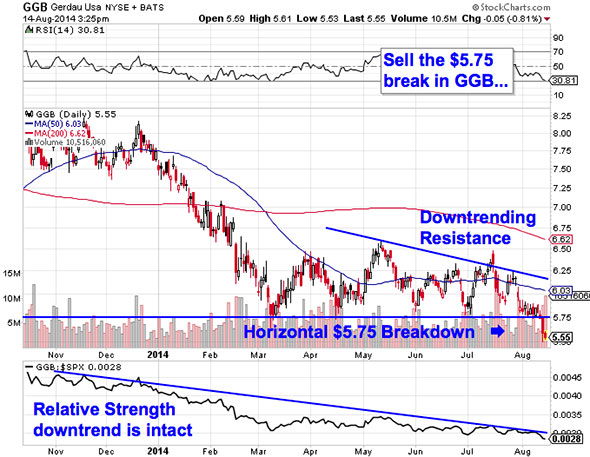
Up first is Brazilian steel stock Gerdau (GGB) a name that's been one of the NYSE's worst large-cap performers this year. Since the start of January, Gerdau is down more than 29%. Truth be told, GGB has been looking bearish for a while now. If you'd sold it the last time it looked toxic, you'd have spared yourself close to 11% losses.
But shares look primed for another leg lower from here -- and Gerdau is worth an updated look today.
GGB spent most of 2014 forming a bearish descending triangle pattern. The descending triangle is a price pattern that's formed by horizontal support below shares (in this case at $5.75) and downtrending resistance to the topside. As GGB bounced in between those two technically important levels, it was getting squeezed closer and closer to a breakdown below that $5.75 price floor. That sell trigger happened on Tuesday.
That means that if you own GGB, it's time to unload this stock.
That bearish bet is being confirmed by relative strength in GGB. This stock's relative strength line has been downtrend all year long, an indication that Gerdau is underperforming the rest of the market. That's a big red flag to heed in shares this week.
Read More: 3 Stocks Spiking on Big Volume
The Medicines Co.
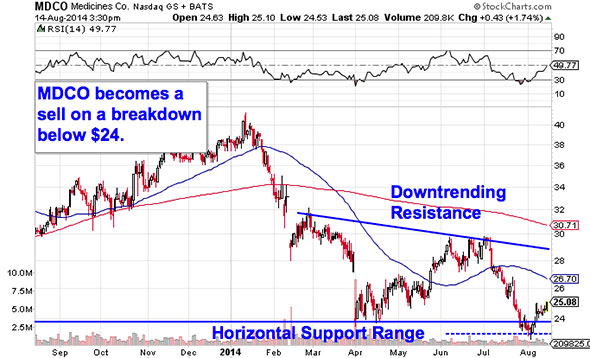
We're seeing the exact same price setup in shares of small-cap pharmaceutical name The Medicines Co. (MDCO) this week. Just like Gerdau, MDCO has spent the last several months trading in a descending triangle setup; the key difference here is that this trade hasn't triggered yet. The sell signal comes in on a break below support down at $24.
Why all of the significance at $24? It's not magic. Whenever you're looking at any technical price pattern, it's critical to keep buyers and sellers in mind. Patterns like the descending triangle are a good way to quickly describe what's going on in a stock, but they're not the reason it's tradable. Instead, it all comes down to supply and demand for shares.
That $24 level in MDCO is the spot where there's previously been an excess of demand for shares; in other words, it's a price where buyers have been more eager to step in and buy shares at a lower price than sellers were to sell. That's what makes a breakdown below support so significant -- the move means that sellers are finally strong enough to absorb all of the excess demand at the at price level. While MDCO could still have some upside in the near-term and stay within the triangle, it's a name best avoided this summer.
Read More: Trade These 5 Consumer Stocks for Gains in August
Regency Energy Partners
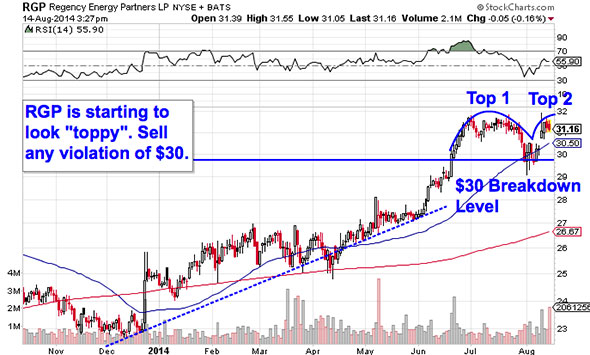
Regency Energy Partners (RGP), on the other hand, hasn't been bleeding off all year long. In fact, this $11 billion natural gas play is actually up close to 20% year-to-date, stomping the broad market by comparison. But bulls should think about taking gains here. After a long run higher, RGP is starting to look "toppy."
Regency is in the early stages of forming a double top pattern. The double top looks just like it sounds: it's a bearish reversal trade that's formed by a pair of swing highs that top out at approximately the same price level. The sell signal comes on a violation of the support level that separates the tops, that $30 price floor in the case of RGP.
That doesn't mean that lower levels are a foregone conclusion just yet. Since Regency's topping pattern hasn't triggered yet, it has a way out if buyers can muster the strength to propel shares past $32. If you don't want to take the downside chance past $30, the best way to manage the risks in RGP is with a tactical stop loss. I'd recommend putting a stop on the other side of the 5 Rocket Stocks to Buy for Gains This Week
Juniper Networks
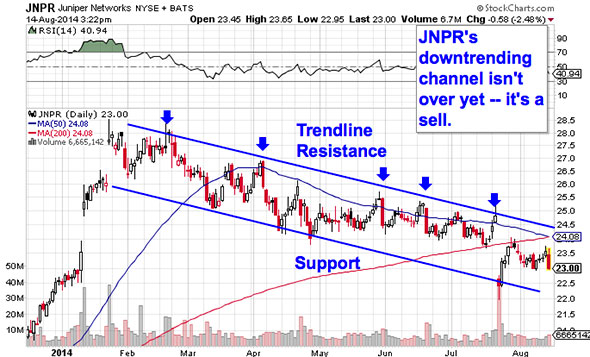
2014 has been a rough year for shareholders in Juniper Networks (JNPR). Since shares peaked in January, this stock has dropped to the tune of 17%. The bad news is that this stock isn't showing any signs of ending that selloff. The good news is that you don't have to be an expert technical trader to figure out what's going on here.
The price action in Juniper Networks is about as simple as it gets. JNPR has been bouncing its way lower in a textbook downtrending channel since last September, swatted lower on each successive test of trend line resistance. That pair of parallel trend lines on Juniper's chart defined the high-probability range for shares of JNPR to trade within. And since those lines are pointing down and to the right, it makes sense to stay out of this stock in August. It's really just as simple as that.
I'd recommend staying away from the long-side of JNPR until shares can press up through their 50-day moving average, a level that's been a good proxy for trend line resistance on the way down. Until that happens, the downtrend is intact.
Read More: 5 Hated Earnings Stocks You Should Love
Agrium
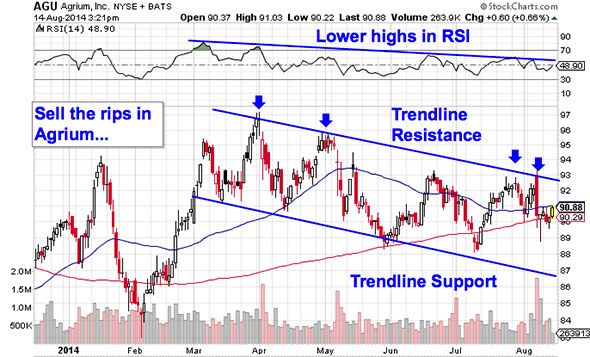
$13 billion agricultural chemical maker Agrium (AGU) is another name that's working its way lower in a textbook downtrend this month. Shares bounced off resistance for a fourth time at the beginning of the month, giving us another high-probability sell signal for this toxic stock.
Waiting for that bounce lower before clicking "sell" is a critical part of risk management, for two big reasons: it's the spot where prices are the highest within the channel, and alternatively it's the spot where you'll get the first indication that the downtrend is ending. Remember, all trend lines do eventually break, but by actually waiting for the bounce to happen first, you're confirming that sellers are still in control before you unload shares of AGU.
We're getting confirmation right now from momentum, measured by 14-day RSI. Our momentum gauge has been making lower highs over the course of the channel, an indication that buying pressure is still waning. Consider that a big red flag for AGU this summer.
To see this week's trades in action, check out the Toxic Stocks portfolio on Stockpickr.
-- Written by Jonas Elmerraji in Baltimore.
RELATED LINKS:
>>3 Huge Stocks to Trade (or Not) >>4 Big-Volume Stocks Triggering Breakout Trades >>4 Big Stocks on Traders' Radars
Follow Stockpickr on Twitter and become a fan on Facebook.
At the time of publication, author had no positions in stocks mentioned.
Jonas Elmerraji, CMT, is a senior market analyst at Agora Financial in Baltimore and a contributor to TheStreet. Before that, he managed a portfolio of stocks for an investment advisory returned 15% in 2008. He has been featured in Forbes , Investor's Business Daily, and on CNBC.com. Jonas holds a degree in financial economics from UMBC and the Chartered Market Technician designation.
Follow Jonas on Twitter @JonasElmerraji
